Testing Practicies not only in Scala
by Paweł Panasewicz
pawel.panasewicz(at)gmail.com
@pawelpanasewicz
github.com/PawelPanasewicz
... actually ...
ScaLAB Conference, 2016 Wrocław
Who am I
- Professionally for > 10 years in Software Development
- mostly in commercial projects
- Impressed by Scala Language and Functional Approach
- In free time
- engaged in Music Production
- learning about Artificial Intelligence
- like to ride bicycle

Prologue
The Analyst
val analyst = //there was an analyst
Analyst(whatLearnt = Set()) //at the beginning he knew not a lot
.copy(whatLearnt = Set(UML, SQL, XML)) //but in time he's achieved skills
analyst
.changeYear(_ + 5) //... few years later
.`are my skills still up to date` //?
//👍 All Skills Up To Date
The Project Manager
val manager = //there was a project manager
ProjectManager(whatLearnt = Set()) //at the beginning he knew not a lot
.copy(whatLearnt = Set(GantChart,
ManagingStyles.visionary, WritingSolemnEmails,
ManagingStyles.commanding)
) //but in time he's achieved skills
manager
.changeYear(_ + 5) //... few years later
.`are my skills still up to date` //?
//👍 All Skills Up To Date
The Software Developer
val developer = //there was a software developer
Developer(whatLearnt = Set()) //at the beginning he knew not a lot
.copy(whatLearnt = Set(
Slick1, Slick2, Spray1, Angular1, play1,
`play < 2.5`, `your favourite example of not to old tech`
)) //intelligent beast has learnt a lot
developer
.changeYear(_ + 5) //... few years later
.`are my skills still up to date` //?
// 😕 Well Not Really
So what?
- The best-before date of IT technologies are often short space of time
- As good Software Developer you have to frequently update your skills
- It would be nice if there were some areas which don't change so rapidly
- because you could successfully take advantages of them for long time
- Well, there are such areas and among them:
- Design Patterns
- Software Development Philosophies
- Shortcuts in Intellij and Vim
- Testing 😎
Agenda
- Why to test code?
- What code testing is all about?
- Good practicies
in order to deliver high quality sofware and be safe
In general
Why
to test code?
Why
In particular
to test code?
- to demonstrate that the software satisfies its specification
- to find bugs during development phase, not during production run
- to be safe when refactoring - tests will notify me when introducing regression errors
- I want to show the estimation of work done - there is as much progress as many test scenarios in code base
- I want to document how my codes and whole system works - it's helpfull not only for other devs but as well managers, analysts and users.
- TDD techniques guide mu during development
- ATDD techniques make sure system does what business/users/analysts needs
- I want to report performance of my application
- I want to repair system because of the bug on production - first I develop the failing test which reprodces the error, next I can fix it
- I am just a prone to make mistakes human
- many other factors inlcuding ~120 Mega results from google.com:
In particular
Why
to test code?
What
is code testing all about?
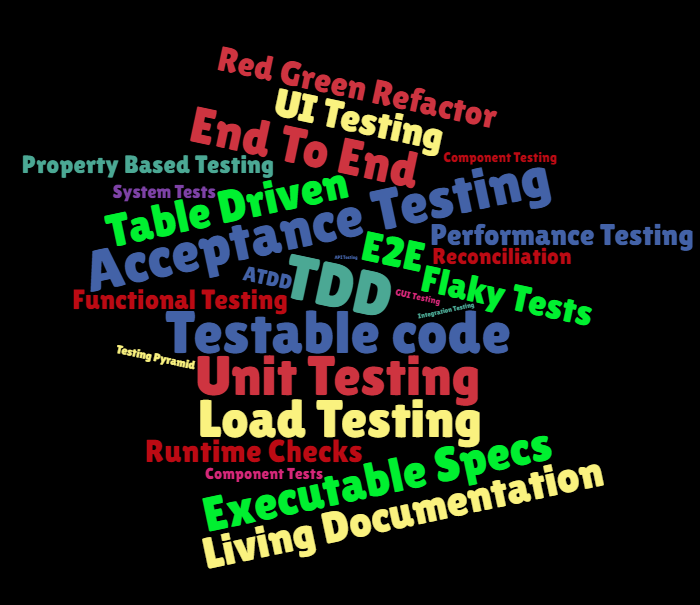
Code testing is all about writing another code which will satisfy needs mentioned in the "Why" section
In general
In particular
Piece of code

definition
Unit & Integration tests
what are?
code code code code code ... code code code code code
these kind of codes are tested by integration tests
these kind of codes are tested by unit tests
one big integrated code
perfect undivided unit of code
E2E, System Tests
Acceptance, Functional, UI
API Tests
Component,
Isolated UI,
Just Unit Test
- tests are performed when application is deployed on environment
- tests are performed during builds and development
- they test if many components cooperate well together
- by developers not only to developers
- slower
- they test behaviour of relative small pieces of code in isolation
- by developers to developers
- easy to test many scenarios and hunt a bug
- fast
- mocking
Acceptance/Functinal tests
Unit tests
Unit vs Functional
tests
- ensure that app works according to business requirements (whatever the implementation is)
- do assure that developer's design is in accordance with business requirements
- functionality guards
- more parts together then less worries
-
ensure that piece of code works according to developer's design
-
do not assure that developer's design is in accordance with business requirements
- it's often silently assumed that mocked dependecies will behave in particular way which is dangerous 'cuz unit tests will not cover that
when designing new functionality
Unit vs Functional
Acceptance/Functinal tests
Unit tests
Plan of attack
when delivering new functionality
- Start from basic acceptance tests
- Keep on refactoring
- When requirements and architecture stops evolving hunt for bugs using extensive Unit Tests
Good Practicies
advices when testing
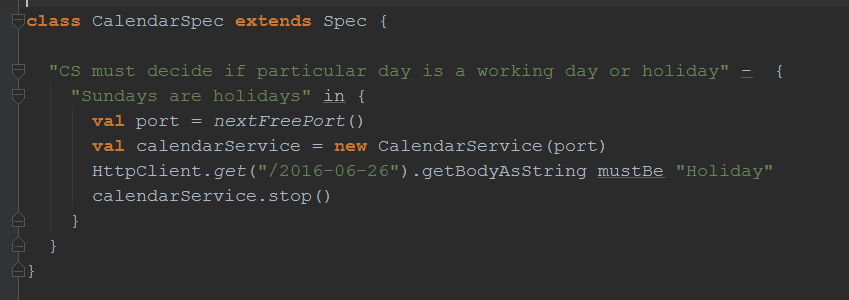
- Develop Calendar Service
- CS must decide if particular day is a working day or a holiday
- API exposed in rest-like form
The Calendar Service
Example

BTW There are two devs delegeted to this task
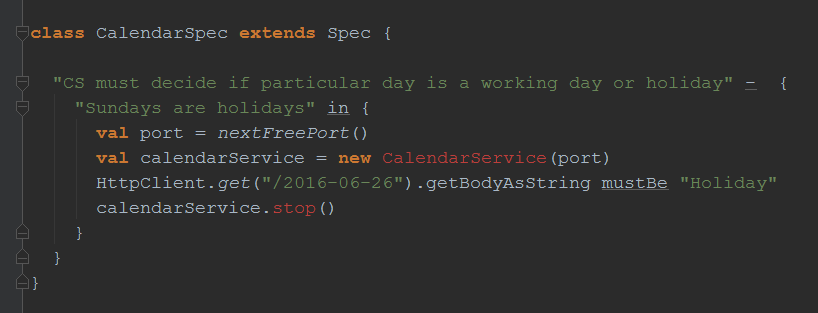
Let's assume that we are using ScalaTest , and somehow there are imported testing goodies like HttpClient and nextFreePort() ...
First

Hmm, a little bit red, let's create the simplest implementation
small happy path acceptance scenario
Test Run
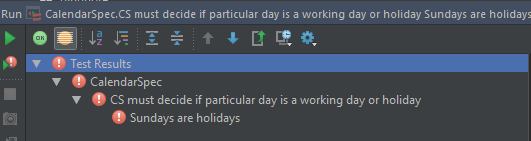
failed red
Implementation
as simple as needed
- keybord is swapped and second developer is making implementation whereas the first one is observing
- (no slide with code with correct implementation, sorry for that)
green
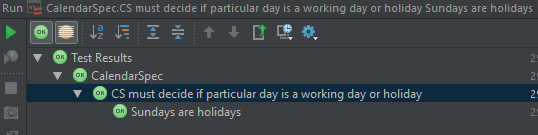
Test re-run
once again
great success !
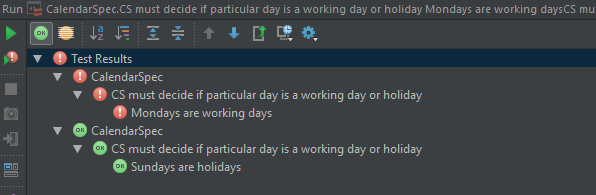
Mondays are working days
more happy paths
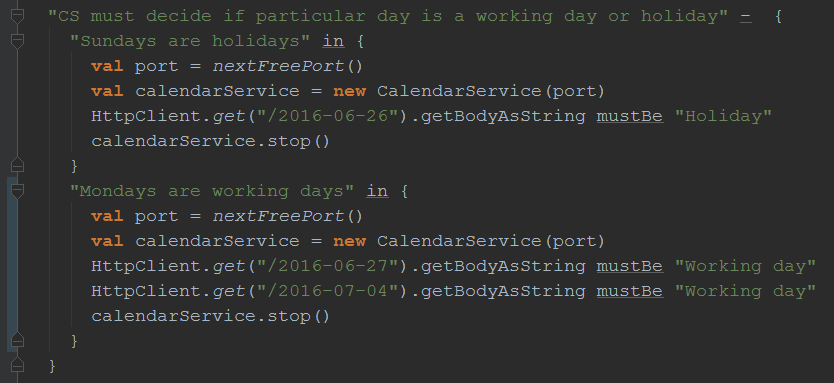
- keybord is swapped, the second dev is observing now
- new testcases (still happy paths) are made
red
Test re-run
once again
Implementation
without extra features
- keybord is swapped and second developer is making implementation whereas the first one is observing
- (no slide with code with correct implementation, sorry for that)
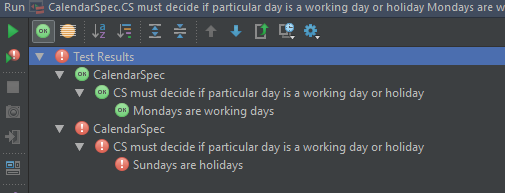
red
Test re-run
and regression error found
- ooopps, something went wrong ...
- REGRESSION ERROR introduced
- Tests are for rescue 😎
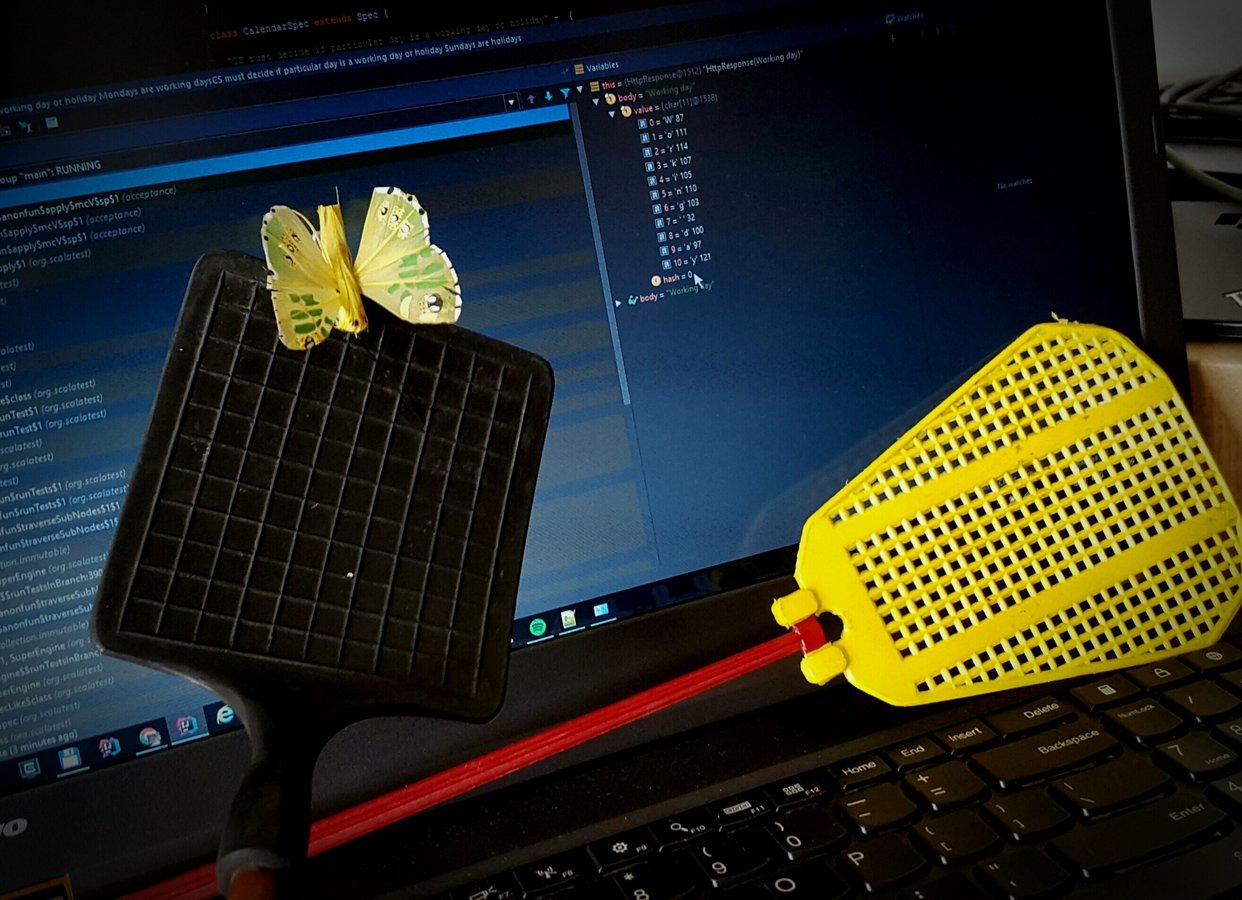
Implementation
and debugging
- keybord is swapped and second developer is making implementation whereas the first one is observing
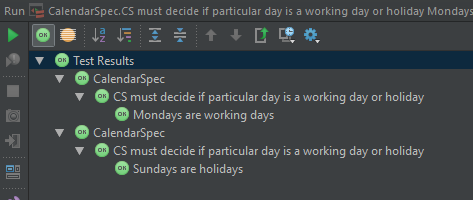
red
Test re-run
all green
Refactoring
optimise readability, make it beautiful
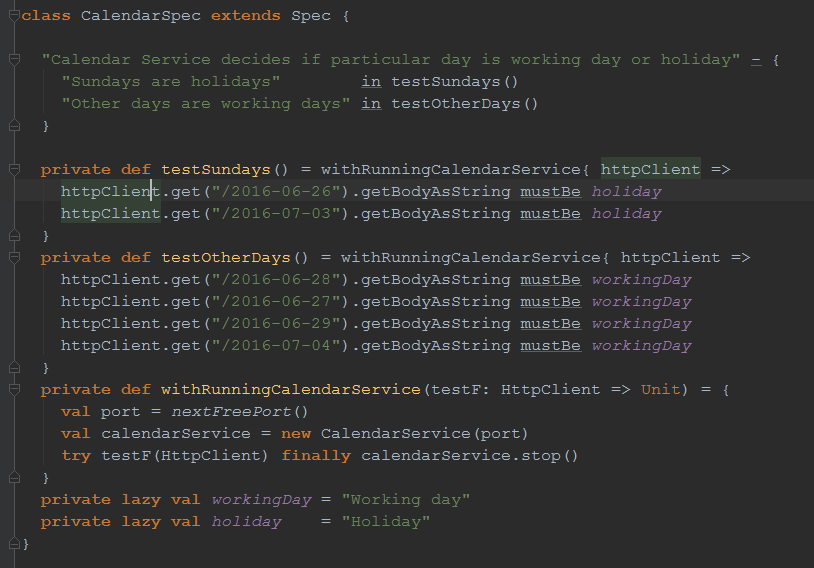
"table of contents"
private guts in descendent order of importance
red
Test re-run
all green
Quiz
Which "design patterns" have you noticed here?
- Make it testable - the most important
- TDD (or even ATDD or BDD)
- Red Green Refactor
- Happy Path first
- Important goes up
- Pair Programming
- Baby steps
- almost like a "pure function"
- KISS

The Calendar Service
new requirements
- different clients of CS have different working days
- default functionality must be preserved
Meet the Table
and put test cases in such form
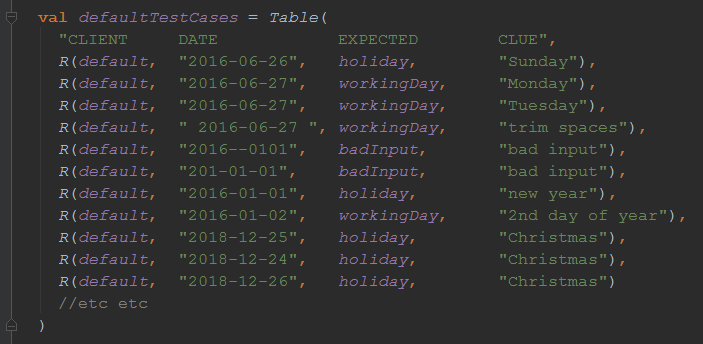
- easy to create new test cases
- easy to read
"Table of contents"
still in front of spec
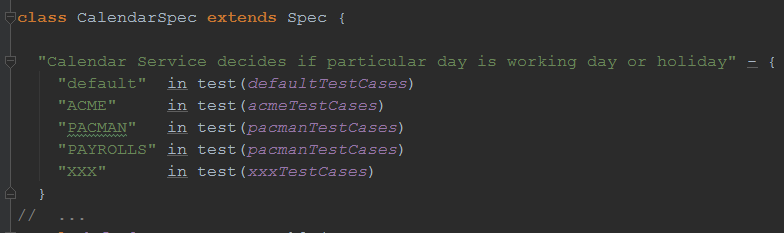

and test routine may look like this:
Quiz
Which new "design patterns" have you noticed here?
- Table Driven Testing
The Calendar Service
new requirements
- it must be documented
- documentation must be always up to date
Documenting
the functionality
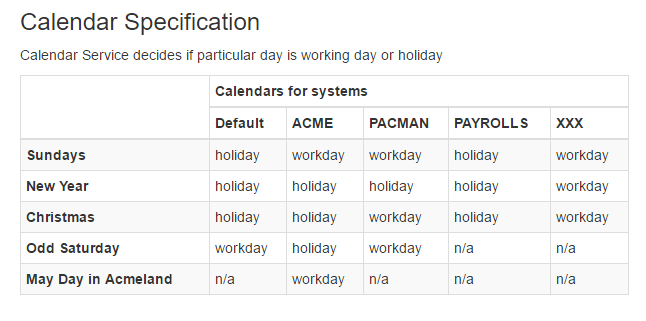
Under the hood
it's just simple HTML
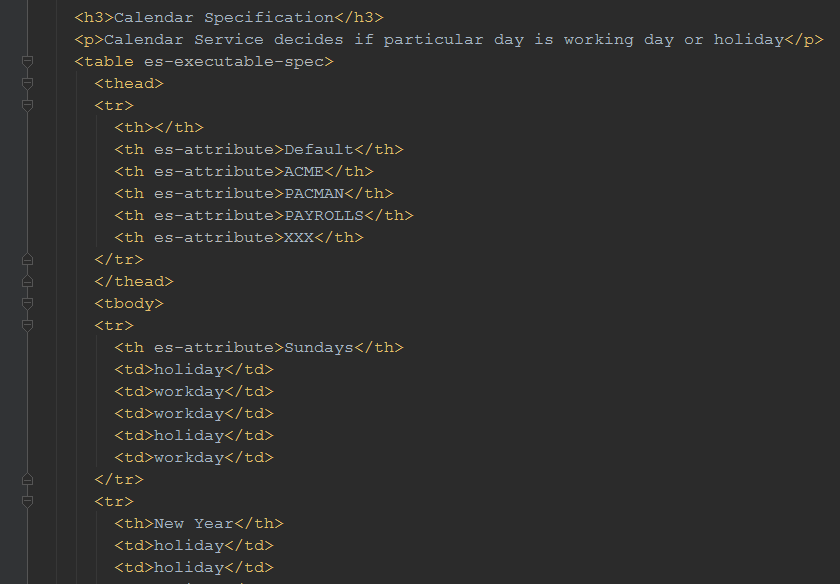
- extra html attributes
- part of resources
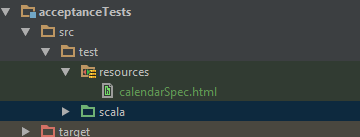
Executing Spec
is performed during tests
- Html document can be parsed
- Extra HTML attribues can help in that
- Extracted values can be seen as:
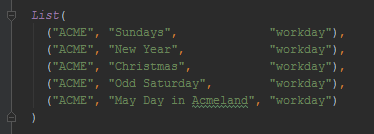
- and can be used to generate many testcases
- which can be used for testing
Spec output
after test run
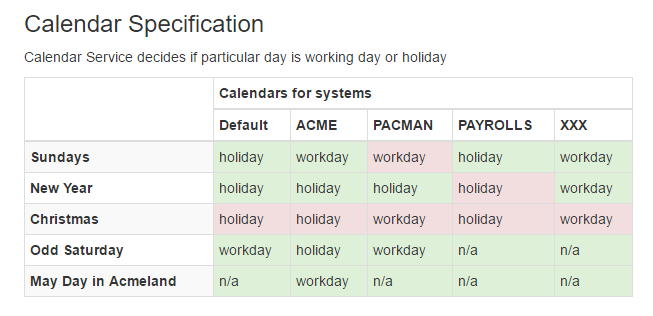
- green - tests succeded
- red - tests failed
Quiz
Which new "design patterns" have you noticed here?
- Executable Spec (Living Documentation)
Living Documentation
closer look at
- Engage [developers] with your users
- Create a shared domain language
- Build mutually-understood delivery contracts
- Describe the system concisely, so that errors and redundancy are easily visible
- Write living documentation: always coupled to the actual behaviour of the system
- Chris Agmen Smith - autor of Petswood
- Petswood - scala framework for it
- Living doumentation - Free ebook
The Calendar Service
new requirements
- web page
Project of web page
functionality
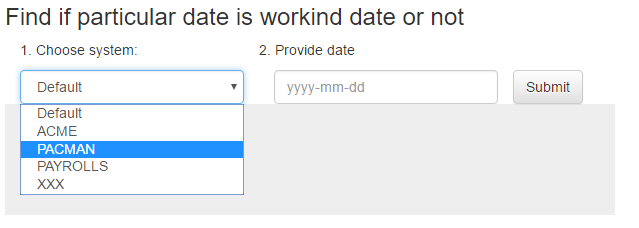
Choose system, provide date string, click submit. There should appear message "working day" or "holiday" i n gray area. (sorry for typos)
Test routine
could look like this
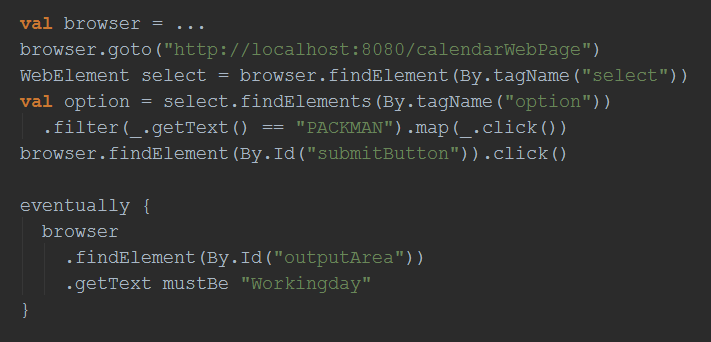
it's ugly, unreadable
Abstract
over it
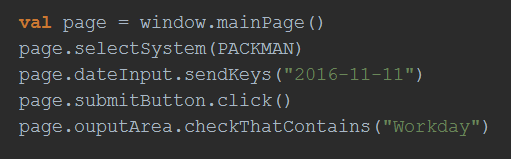
- create high level API for manipulating the page
- API can contain assertions (checkThatContains)
- API can be reused
- nicely explains what the test does
Quiz
Which design pattern have you noticed here?
Other techniques
handy when testing
Bob Snaphot's
technique
- record input and output and use this data for testing
- if actual output during tests differs from recorded that means that regression errors were introduced
- save output to files when test run and use diff tool for fast spot differences
- use it
- when you don't really know what right behaviour/ouptut should be
- only subject expert matter can decide if behaviour is fine
- when you render something
More test code lines
then production code lines
- It's good sign
- measure it
howitworks
package
- use it as playground when learning something new which might be used in project
- easy to copy/paste working solution
- easy to remove when not needed or disturbing
- often better then stackoverflow
Domain Test Data in one place
good practice
- test data builders and factories
- example data in one place
- even identifiers of rows id DB and their values
- understanding domain data is key to understand what system is supposed to do
That's it
Thank you!
Questions?